When we fall ill, our body is not merely suffering from a localized physical intrusion; it is expressing a deeper, systemic disharmony. Both Homeopathy and Traditional Chinese Medicine operate on this foundational premise. Rather than merely suppressing isolated symptoms, both systems look at the individual as an integrated whole, intertwining the physical body, the mind, and the emotions to restore the body’s natural capacity for self-healing.
While they originate from different eras and cultural landscapes, homeopathy and Traditional Chinese Medicine share a profound respect for the body’s innate wisdom, though they employ distinct maps to navigate the path back to health.
Parallel Paths: How Homeopathy and Traditional Chinese Medicine Compare
To understand how these two modalities support holistic recovery, it is helpful to look at their core similarities and differences.
The Commonalities: A Holistic and Individualized View
- The Vital Energy: Both systems recognize an underlying energetic force that governs health. In Traditional Chinese Medicine, this is Qi, the vital energy flowing through meridians. In Homeopathy, it is the Vital Force, the unseen energy that maintains balance within our physical and mental systems.
- Mind-Body Connection: Neither system separates emotions from physical ailments. A person’s emotional state, such as grief, fear, or irritability, is considered a key symptom that points directly to the correct treatment.
- No One Size Fits All: If ten people have the common cold, they might receive ten different remedies in homeopathy, or ten different herbal formulas in Traditional Chinese Medicine, depending on their unique energetic constitution and symptom expression.
The Differences: Methodologies of Balance
- The Principle of Action:
- Homeopathy operates on the Law of Similars. It uses highly diluted substances that, in their raw form, would cause similar symptoms in a healthy person, thereby gently stimulating the Vital Force to trigger a self-healing response.
- Traditional Chinese Medicine operates on the principle of opposites and balance, utilizing Yin-Yang and the Five Elements. It utilizes synergistic herbal formulas by combining multiple herbs and acupuncture to clear blockages, nourish deficiencies, or drain excesses.
- Symptom Mapping:
- Homeopathy relies heavily on Modalities, which are the specific factors that make a person feel better or worse, such as cold applications, movement, or the time of day.
- Traditional Chinese Medicine relies heavily on Pattern Differentiation, examining the pulse, tongue, and the flow of Qi through specific organ networks.
Deciphering Colds and Flu: A Comparative Study
To illustrate these philosophies in action, let us look at how both systems analyze and address seasonal colds and influenza.
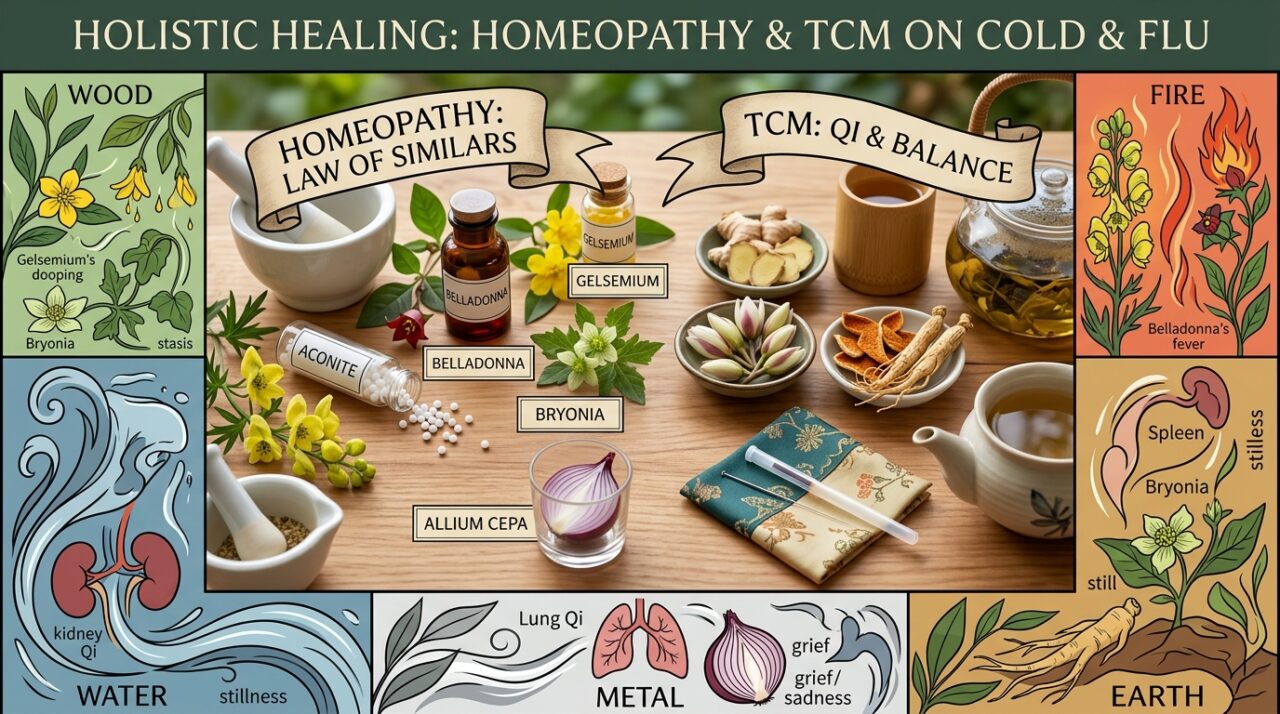
Part A: Traditional Chinese Medicine and The Five Elements
In Traditional Chinese Medicine, the seasonal cold or flu is often viewed as an invasion of external pathogens, such as Wind-Cold or Wind-Heat, overcoming the body's defensive energy, known as Wei Qi.
To understand this holistically, we look to the Five Elements:
- The Metal Element: This element corresponds to the Lungs and Large Intestine. The Lungs govern respiration, dominate the skin and hair, and regulate the Wei Qi immune barrier. When the Metal element is weak, we become highly susceptible to environmental changes, leading to respiratory symptoms, sneezing, and chills.
- The Emotional Link: The emotion tied to the Metal element is grief and sadness. Deep or unresolved grief directly weakens Lung Qi. When our Lung Qi is depleted by emotional stress, our defensive shield of Wei Qi drops, making us far more vulnerable to catching a cold or flu.
- The Element Cycle: Under the Five Elements theory, the Spleen, which represents the Earth element, is the mother of the Lungs, representing the Metal element. If a person is constantly worrying, which is the emotion of Earth, and has poor digestion, the Spleen cannot support the Lungs, leading to excess phlegm and a sluggish immune response during flu season.
Part B: Homeopathy’s Top 5 Cold and Flu Remedies
While Traditional Chinese Medicine categorizes these symptoms through the lens of organ Qi and the Five Elements, Homeopathy matches the patient's exact physical, modal, and emotional state to a highly specific remedy. Here is how the top five remedies address the whole person:
1. Aconite — The Sudden Onset
- Symptom Picture: A cold or fever that strikes with intense suddenness, often after exposure to cold, dry winds, mirroring a sudden Wind-Cold invasion in Traditional Chinese Medicine.
- Modalities: Symptoms often worsen around midnight; the patient experiences intense thirst for cold water.
- Emotion and Mind: The hallmark of Aconite is extreme anxiety, restlessness, and a sudden fear. The mind is in a state of high alert.
2. Belladonna — The Fiery Intensity
- Symptom Picture: Sudden, high-grade fever with a flushed red face, hot skin, dilated pupils, and throbbing pain, comparable to acute Wind-Heat in Traditional Chinese Medicine.
- Modalities: Worse from touch, motion, light, or noise; better from resting in a quiet, dark room.
- Emotion and Mind: The patient is highly sensitive, easily startled, and may experience mild delirium or vivid dreams due to the intense heat.
3. Gelsemium — The Heavy Dullness
- Symptom Picture: A slow, creeping flu characterized by the three Ds: Dullness, Drowsiness, and Dizziness. The limbs feel heavy, the eyelids droop, and there are chills running up and down the spine. The patient is completely thirstless.
- Modalities: Worse from damp weather, warmth, or physical effort. Better after urination or in the open air.
- Emotion and Mind: The mental state is one of apathy and quiet exhaustion. The patient dreads any movement and simply wants to be left alone to sleep.
4. Bryonia — The Motionless Irritability
- Symptom Picture: A slow-developing cold that settles in the chest with intense dryness, such as dry throat, dry cough, and a thirst for large quantities of cold water at long intervals.
- Modalities: Worse from any movement, even moving the eyes. Better from absolute rest and lying on the painful side, which applies firm pressure.
- Emotion and Mind: The patient is highly irritable and grumpy. They may talk excessively about business or work, and express a strong desire to go home, even when they are already in their own bed.
5. Allium cepa — The Streaming Cold
- Symptom Picture: Profuse, watery nasal discharge that is burning, causing redness and raw skin around the nostrils and upper lip. This is accompanied by frequent sneezing and watery eyes with bland, non-irritating discharge.
- Modalities: Worse in a warm room and in the evening. Significantly better in fresh, open air.
- Emotion and Mind: The individual may feel anxious, dull, or fearful of pain, reacting sensitively to their physical discomfort.
Summary Comparison
- Core Concept: Traditional Chinese Medicine focuses on balancing Yin-Yang, Qi, and the Five Elements, while Homeopathy is based on the Law of Similars.
- Primary Driver: Traditional Chinese Medicine channels the flow of Qi through meridians, while Homeopathy stimulates the Vital Force animating the body.
- View on Cold and Flu: Traditional Chinese Medicine sees external pathogens like Wind-Cold or Wind-Heat invading the Lungs, whereas Homeopathy sees an energetic imbalance reflecting a specific physical and emotional symptom profile.
- Mind-Body Connection: Traditional Chinese Medicine believes emotions like grief directly weaken organ Qi, whereas Homeopathy uses the emotional state, such as fear or irritability, as a vital indicator for choosing the remedy.
- Treatment Tool: Traditional Chinese Medicine uses synergistic herbal formulas and acupuncture, while Homeopathy uses highly diluted, potentized single substances.
Conclusion
Both homeopathy and Traditional Chinese Medicine offer gentle, supportive paradigms for health that honor the complexity of human biology and emotion. By looking beyond the physical cough or fever, these therapies invite us to listen to the subtle language of our bodies. Whether navigating the flow of Qi and the Five Elements or finding the precise energetic resonance of a homeopathic remedy, the goal remains beautifully aligned: to gently support the body so it can restore its own dynamic state of health.
整體自癒的共鳴:探討順勢療法與中醫在感冒和流感護理中的同與異
當我們生病時,身體不單是受到局部生理系統的入侵,更是在反映深層的、系統性的失衡。順勢療法與傳統中醫均建立於這一核心前提之上。這兩門學問並非單純壓制個別症狀,而是將個體視為一個有機的整體,將身體、心智與情緒相互編織,以激發和恢復人體自身的天然自癒能力。
雖然兩者誕生於不同的時代與文化背景,但同樣對人體的內在智慧抱有深切敬意。然而,在引領人體重回健康之路上,它們各自繪製了獨特的導航地圖。
平行的自癒之路:順勢療法與中醫的比較
要理解這兩種療法如何支持整體康復,我們可以先看看它們的核心相同與不同之處。
共同點:整體觀與個體化
- 生命的能量: 兩種系統都承認有一股主導健康的內在能量。在中醫裏,這是氣,即流經經絡的生命能量;在順勢療法中,這被稱為生命力,即維持生理與心理平衡的無形能量。
- 身心相連: 兩者皆不會將情緒與生理病痛割裂。患者的情緒狀態,如悲傷、恐懼、焦慮或易怒,被視為指向正確治療的關鍵臨床線索。
- 因人而異: 如果有十個患上感冒的人,在順勢療法中可能會獲得十種不同的療劑;在中醫裏,亦可能配備十種不同的中藥方劑,這完全取決於個人獨特的體質與症狀表現。
不同點:實現平衡的方法論
- 作用機制:
- 順勢療法 遵循同類法則,即以同類物質治療同類症狀。它使用經過高度稀釋與振盪的天然物質,這些物質在原始狀態下會令健康人士產生類似症狀,藉此溫和刺激人體的生命力,從而啟動自癒機制。
- 傳統中醫 則基於陰陽平衡與五行學說。中醫透過複方中藥,即結合多種草藥的協同作用,或以針灸來調和陰陽、疏通經絡、補虛瀉實。
- 症狀辨識:
- 順勢療法極為注重加重與減輕因素,即令患者感到舒服或難受的特定條件,如冷敷、活動或一天的某個特定時段。
- 中醫則依賴辨證論治,透過望、聞、問、切,如觀察舌苔和脈象,判斷體內臟腑氣血的失衡狀態。
感冒與流感剖析:對比研究
為了展示這兩套哲學的實際應用,我們以兩者如何看待和處理季節性感冒和流感為例。
甲部分:傳統中醫與五行學說
在中醫理論中,季節性感冒或流感通常被視為外邪,如風寒或風熱入侵,突破了人體的防禦屏障,即衛氣。
若從整體的視角出發,我們可引入五行來理解:
- 金系統: 在五行中,金對應肺臟與大腸。肺主氣、司呼吸,外合皮毛,並負責宣發衛氣,即我們的免疫防禦力。當金系統氣虛時,身體防禦力下降,極易受外界環境變化影響,進而出現呼吸道症狀、噴嚏與惡寒。
- 情感聯繫: 與金相應的情志是悲與憂。長期或未解的悲傷會直接消耗肺氣。當肺氣因情志壓力而受損,衛氣防禦網便會隨之變弱,令外邪有機可乘,引發感冒。
- 五行相生: 根據五行相生理論,土生金,脾為肺之母。若一個人經常憂慮,即土之情志,且消化不良,脾胃便無法化生足夠的精微物質來滋養肺部,導致土不生金,在流感季節便容易產生痰濕、免疫力低下。
乙部分:順勢療法最常用的五大感冒與流感療劑
中醫透過臟腑氣血與五行辨證感冒,而順勢療法則將患者的生理症狀、加重與減輕因素,以及心智與情緒狀態,與特定的單一療劑進行精密匹配。以下是五種最經典的流感療劑及其對整體身心的照顧:
1. 藍烏頭 — 起病急驟
- 生理症狀: 惡寒或發熱起病極為迅速、猛烈,通常在吹了寒冷乾風後發病,這與中醫的外感風寒極為相似。
- 加重與減輕因素: 症狀往往在午夜前後加劇;患者極度口渴,渴望飲用大量冷水。
- 情緒與心智: 此療劑的標誌是極度焦慮、煩躁不安,並伴隨強烈的恐懼感。患者的神經系統處於高度警戒狀態。
2. 顛茄 — 如火般熾熱
- 生理症狀: 突然高燒、面色通紅、皮膚滾燙、瞳孔放大,並伴有搏動性或跳痛式的頭痛,類似中醫急性的外感風熱。
- 加重與減輕因素: 因震動、觸碰、光線或噪音而明顯惡化;在安靜、黑暗的房間中休息會感到舒服。
- 情緒與心智: 患者極為敏感、易受驚嚇,在高熱時甚至會出現輕微的神志不敏或產生幻覺。
3. 黃素馨 — 沉重與倦怠
- 生理症狀: 起病緩慢,呈現三D症狀,即遲鈍、嗜睡與頭暈。四肢沉重如灌鉛,眼瞼下垂,並感到有冷感沿脊椎上下遊走。患者完全不口渴。
- 加重與減輕因素: 潮濕天氣、溫暖環境或身體活動會令症狀惡化;小便後或處於戶外清新空氣中會感到舒緩。
- 情緒與心智: 精神呈現冷漠與極度疲憊狀態。患者抗拒任何活動,只想被獨自留下靜靜睡覺。
4. 白瀉根 — 動輒得咎與易怒
- 生理症狀: 起病較慢,感冒往下蔓延至氣管,表現為極度乾燥,如口乾、黏膜乾、乾咳,且渴望大口飲用冰水。
- 加重與減輕因素: 因任何微小的活動而惡化,甚至連轉動眼睛也會引起不適。絕對靜臥,或朝向疼痛患側側臥,藉由身體加壓會感到緩解。
- 情緒與心智: 患者非常易怒、脾氣暴躁。生病時常會焦慮地提及工作,並表現出強烈想回家的渴望,即使當時已躺在自家的床上。
5. 洋蔥 — 流涕不止
- 生理症狀: 狂流清涕,且鼻涕具有灼熱感,導致鼻孔周圍及上唇發紅、刺痛。伴隨頻繁打噴嚏,而眼淚則是溫和且無刺激性的。
- 加重與減輕因素: 處於溫暖的房間或傍晚時症狀惡化;在戶外新鮮空氣中顯著改善。
- 情緒與心智: 患者可能感到焦慮、思緒遲鈍,對身體的不適反應較為敏感。
兩者對比總覽
- 核心理念: 傳統中醫聚焦於調和陰陽、平衡氣血與五行運作,而順勢療法則基於同類法則。
- 主要驅動力: 傳統中醫調節經絡中氣的流動,而順勢療法則溫和刺激維持生命的生命力。
- 對感冒的解讀: 傳統中醫視外感風寒或風熱等外邪入侵肺臟,而順勢療法則視其為內在能量失衡表現出的特定身心症狀組合。
- 身心與情緒: 傳統中醫認為情志如悲傷會直接削弱臟腑之氣,而順勢療法則將恐懼或易怒等情緒反應作為挑選療劑的核心指標。
- 調理工具: 傳統中醫使用複方中藥及針灸調理,而順勢療法使用高度稀釋與振盪的單一療劑。
結語
不論是中醫還是順勢療法,都為現代人提供了一種更為溫和、尊重身心複雜性的整體健康視角。它們並不單純着眼於如何消除當下的咳嗽或發燒,而是引導我們去傾聽身體細微的語言。不論是調理五行與氣血的流暢,還是尋找與自身能量共鳴的順勢療劑,兩者的目標殊途同歸:以最溫柔的方式,啟發身體內在的自癒潛能,重拾平衡與健康。