
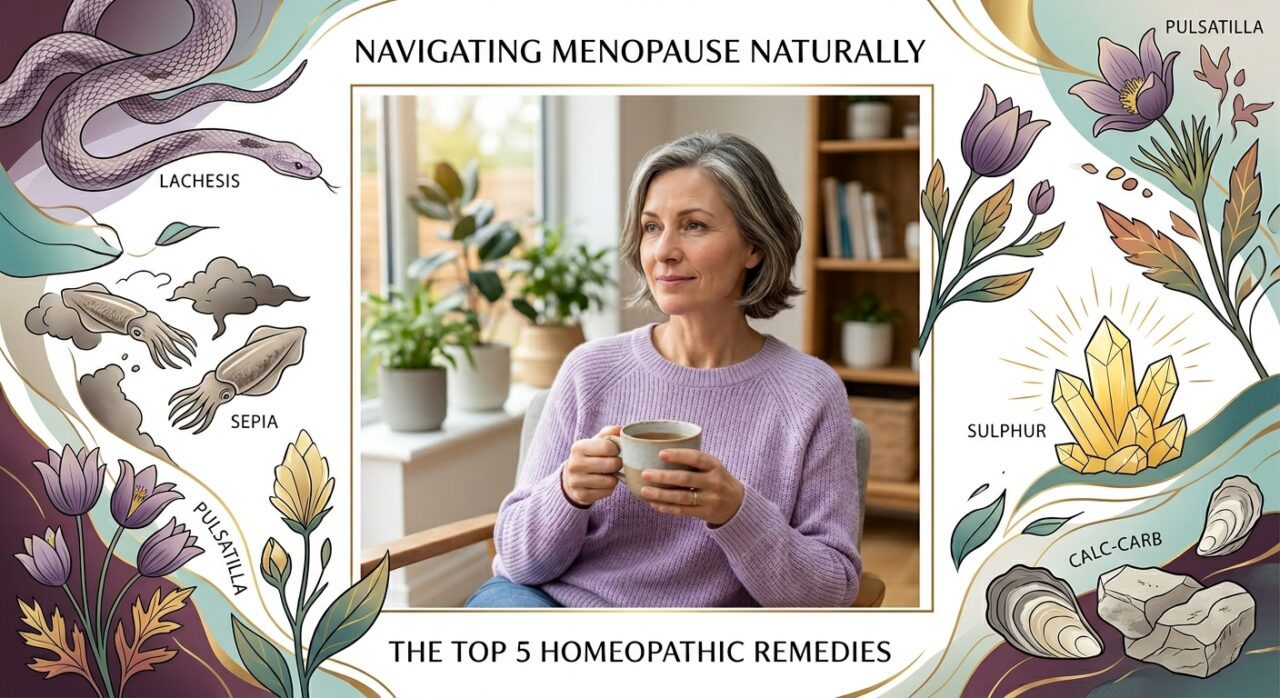
Menopause is a natural transitional phase in a woman’s life, marking the end of her reproductive years. While it is a normal biological process, the hormonal fluctuations can lead to a wide range of physical and emotional challenges.
In classical homeopathy, menopause is not viewed as a disease to be cured, but as a period of adjustment. Homeopathic care focuses on the individual rather than the diagnosis. By analyzing a person's specific physical symptoms, modalities (what makes the symptoms better or worse), and mental/emotional state, a homeopath selects a remedy that matches their unique profile to help restore internal balance.
Below are the top 5 homeopathic remedies commonly used to support women during menopause, categorized by their distinct symptom patterns, modalities, and emotional expressions.
1. Lachesis (Lachesis mutus)
Lachesis is often indicated for women who experience intense heat and congestion during menopause, particularly when symptoms feel "blocked" or worse after sleep.
- Physical Symptoms: Intense hot flashes that start from the chest and move upwards, accompanied by a choking or suffocating sensation. Night sweats are common. Left-sided symptoms are prevalent (e.g., left-sided headaches).
- Modalities:
- Worse: After sleeping, in hot weather, and from tight clothing (especially around the neck or waist).
- Better: From open air and from any natural discharge (such as the return of a delayed menstrual flow).
- Emotion & Mind: Highly talkative, rapidly jumping from one topic to another. The individual may experience heightened feelings of jealousy, suspicion, or anxiety. They often feel restriction, both physically and emotionally.
2. Sepia (Sepia officinalis)
Sepia is one of the most prominent remedies for menopause, especially when there is a profound sense of exhaustion, hormonal imbalance, and emotional detachment.
- Physical Symptoms: Hot flashes accompanied by shivering or cold sweats. A characteristic "dragging down" or heavy sensation in the pelvic region, as if the organs need support. Headaches and dryness of vaginal tissues are also common.
- Modalities:
- Worse: In the late afternoon, from cold air, and during rest.
- Better: From vigorous physical exercise (like dancing or fast walking), warmth, and pressure.
- Emotion & Mind: Marked by irritability and emotional exhaustion. The individual may feel an unusual indifference to loved ones (such as family members or children) and a strong desire to be left alone.
3. Pulsatilla (Pulsatilla pratensis)
Pulsatilla is well-suited for women whose menopausal symptoms are highly changeable and who possess a gentle, emotional temperament.
- Physical Symptoms: Hot flashes that alternate with chills. Symptoms are highly variable—no two days or episodes feel exactly the same. They generally experience a lack of thirst, even during hot flashes.
- Modalities:
- Worse: In warm, stuffy rooms, and from eating rich or fatty foods.
- Better: In cool, open air, and with gentle motion.
- Emotion & Mind: Mild, gentle, and yielding disposition. The individual is easily brought to tears and craves sympathy, reassurance, and consolation, which significantly improves their mood.
4. Sulphur
Sulphur is often recommended when heat is the dominant factor in the patient's presentation, affecting both their physical body and their temperament.
- Physical Symptoms: Intense hot flashes with burning sensations, particularly on the top of the head and the soles of the feet. They may kick the covers off at night to cool their feet. Sweating can be profuse and have a strong, sour odor.
- Modalities:
- Worse: From the heat of the bed, standing for long periods, and warm washing.
- Better: From cool air and dry weather.
- Emotion & Mind: Can be irritable, critical, or impatient. They may become highly opinionated or intellectually active, though sometimes lacking the physical energy to follow through.
5. Calcarea Carbonica (Calc-carb)
Calcarea Carbonica is suitable for women who feel easily overwhelmed, fatigued, and physically cold, yet prone to localized sweating.
- Physical Symptoms: Excessive sweating, particularly on the head and back of the neck, which often occurs during sleep and wets the pillow. They tend to gain weight easily during menopause and often complain of cold hands and feet.
- Modalities:
- Worse: From cold, damp weather, and physical or mental exertion.
- Better: In dry weather and warm environments.
- Emotion & Mind: Responsible, hard-working, but easily overwhelmed by duties. They may harbor anxieties about the future, their health, or losing control, and prefer to stay within their comfort zone.
Conclusion
Homeopathy offers a personalized approach to managing the multi-faceted symptoms of menopause. Because remedies are chosen based on the unique combination of physical traits, modalities, and emotional states, consulting a qualified homeopathic practitioner is recommended to find the most appropriate support for your individual transition.
(Below is the Hong Kong Traditional Chinese translation, utilizing common local medical and lifestyle terms.)
自然渡過更年期:順勢療法的溫和守護
更年期(Menopause)是女性生命中一個自然的過渡階段,標誌著生育年齡的結束。雖然這是一個正常的生理過程,但體內荷爾蒙的波動可能會帶來各種生理和情緒上的挑戰。
在經典順勢療法(Classical Homeopathy)的觀點中,更年期並非一種需要被「治癒」的疾病,而是一個身體自我調節的時期。順勢療法注重的是「整體的人」而非單一診斷。透過評估個人的具體症狀、誘因與緩解因素(Modalities,即甚麼情況會令症狀加重或好轉),以及心智與情緒狀態,順勢療法醫生或治療師會挑選最合適的療劑,幫助身體恢復內在的平衡。
以下是五種在更年期期間常用的順勢療法療劑,分別根據其獨特的症狀特徵、緩解/加重因素以及情緒表現進行分析:
1. 枯葉蛇毒 (Lachesis)
枯葉蛇毒通常適用於在更年期經歷強烈潮熱和充血感,且症狀在睡醒後或感到「受壓迫」時尤為嚴重的女性。
- 生理症狀: 強烈的潮熱感,多由胸部開始向上擴散,常伴有窒息感或喉嚨繃緊感。夜間盜汗常見。症狀多出現在左側(例如左側頭痛)。
- 好轉/惡化因素 (Modalities):
- 惡化: 睡醒後、天氣炎熱時,以及穿著緊身衣物(尤其是衣領或腰帶過緊)時。
- 好轉: 身處空氣流通的戶外,或有身體分泌物排出時(例如延遲多時的月經終於來潮)。
- 情緒與心智: 說話滔滔不絕,話題轉移迅速。患者可能會表現出較強的嫉妒心、猜忌或焦慮感。生理和心理上都容易產生被束縛的壓迫感。
2. 墨骨魚(烏賊汁)(Sepia)
墨骨魚是更年期調理中最核心的療劑之一,特別適用於伴隨極度疲憊、荷爾蒙失調以及情緒疏離的患者。
- 生理症狀: 潮熱,但同時伴隨發冷或冒冷汗。骨盆區域有明顯的「下墜感」或沉重感,彷彿內臟需要支撐。亦常見頭痛及陰道乾澀。
- 好轉/惡化因素 (Modalities):
- 惡化: 傍晚時分、身處冷空氣中,以及靜止休息時。
- 好轉: 進行劇烈運動(如跳舞、快步行走)、保暖及適度按壓。
- 情緒與心智: 表現為易怒和情緒耗竭。患者可能對至親(如伴侶或子女)表現出反常的冷漠和疏離感,並強烈渴望獨處。
3. 白頭翁 (Pulsatilla)
白頭翁非常適合那些更年期症狀多變,且性格溫和、感性的女性。
- 生理症狀: 潮熱與畏寒交替出現。症狀極具多變性——每天或每一次發作的感覺都不盡相同。儘管出現潮熱,患者通常仍不覺口渴。
- 好轉/惡化因素 (Modalities):
- 惡化: 身處溫暖、悶熱的室內,以及進食油膩或高脂肪食物後。
- 好轉: 處於涼爽、空氣流通的戶外,以及進行溫和的活動。
- 情緒與心智: 性格溫順、柔和。患者容易流淚,極度渴望得到別人的同情、關注與安慰;而別人的安慰能顯著改善她們的情緒。
4. 硫磺 (Sulphur)
當「燥熱」成為患者生理和性格上的主導特徵時,通常會考慮使用硫磺。
- 生理症狀: 強烈的潮熱並伴有灼熱感,尤其是頭頂和腳底。患者在夜間睡覺時常會因腳底發熱而將腳伸出被子外。汗量多且可能帶有較重的酸味。
- 好轉/惡化因素 (Modalities):
- 惡化: 被窩的熱氣、長時間站立,以及用溫熱的水洗澡。
- 好轉: 涼爽的空氣和乾燥的天氣。
- 情緒與心智: 容易煩躁、挑剔或缺乏耐心。她們可能變得極有主見或思想活躍,但有時會缺乏實踐計劃的體力。
5. 碳酸鈣 (Calcarea Carbonica)
碳酸鈣適合那些容易感到心力交瘁、疲憊、畏寒,但局部地方容易出汗的女性。
- 生理症狀: 汗量極多,特別是頭部和後頸,常在入睡後發生並浸濕枕頭。在更年期期間容易體重增加,並經常手腳冰冷。
- 好轉/惡化因素 (Modalities):
- 惡化: 寒冷、潮濕的天氣,以及體力或腦力的過度消耗。
- 好轉: 乾燥的天氣和溫暖的環境。
- 情緒與心智: 具責任感且工作努力,但容易因繁重的責任而感到不堪重負。患者可能對未來、健康或失去控制產生焦慮,傾向於留在自己的舒適圈內。
結語
順勢療法為應對更年期的多元症狀提供了一種個人化的選擇。由於療劑的選擇取決於個人的生理特徵、誘因與情緒狀態的獨特組合,建議諮詢合資格的順勢療法專業人員,以便為您的個人過渡期找到最合適的調理方案。