
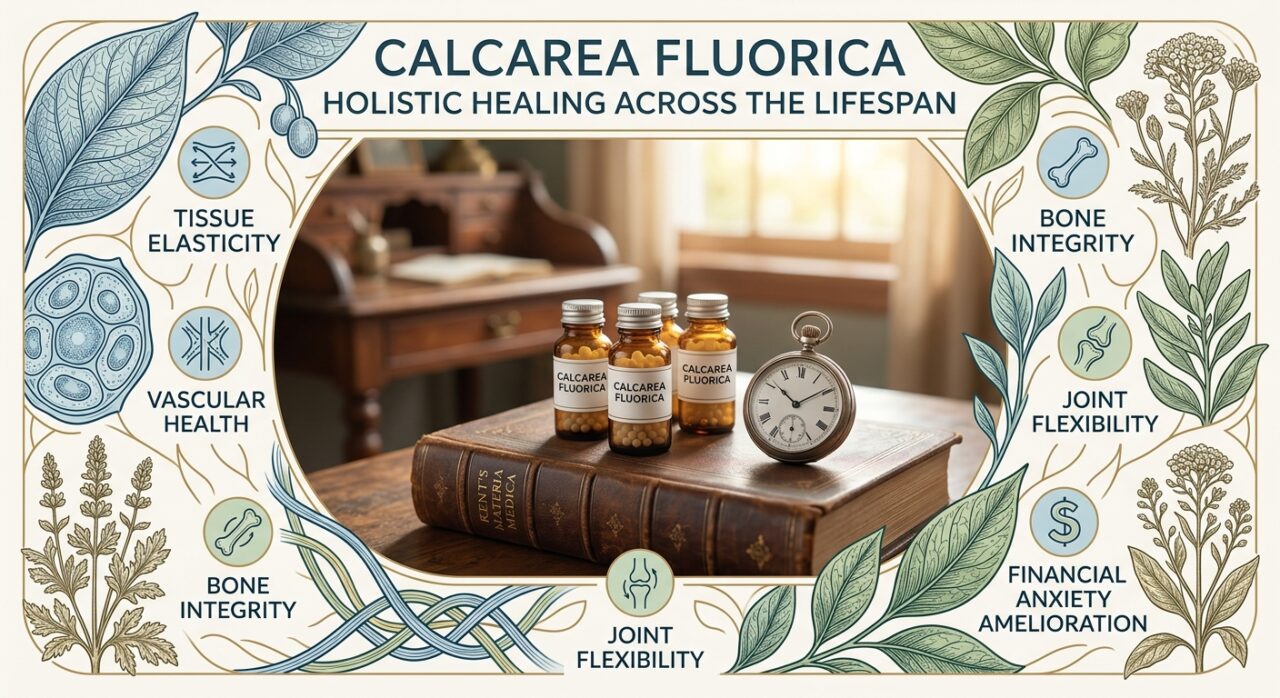
In homeopathic practice, remedies are selected based on their ability to match the individual’s physical, mental, and emotional state. Calcarea Fluorica (Calcium Fluoride), often abbreviated as Calc. Fluor., is one of the twelve tissue remedies identified by Dr. Wilhelm Schüssler, and its deep-acting constitutional effects are well-documented in the classic works of Dr. James Tyler Kent and Dr. William Boericke.
According to these classical texts, the primary sphere of action for Calcarea Fluorica lies in the elastic fibers of the body—including the skin, connective tissues, blood vessels, lymphatic system, and the surface of bones. When the balance of this mineral is disrupted, tissues tend to either lose their elasticity (leading to relaxation and dilation) or become hardened and indurated.
Below is an educational overview of how Calcarea Fluorica is utilized in homeopathy to support health holistically across different stages of life, focusing on its clinical symptoms, modalities, and associated mental states.
1. The Mental and Emotional Sphere
In Kent’s Lectures on Homeopathic Materia Medica, the mental state of the Calcarea Fluorica individual is characterized by a distinct sense of apprehension and insecurity.
- Financial Anxiety: There is a pronounced fear of financial ruin, poverty, or loss of security. The individual may worry excessively about their livelihood, even when there is no immediate cause for concern.
- Indecisiveness and Depression: The person may present as easily fatigued mentally, prone to indecisiveness, and occasionally exhibiting a gloomy or depressed outlook, often linked to their anxieties about the future.
2. Key Modalities (What Aggravates or Ameliorates Symptoms)
Understanding the modalities—the factors that make the patient feel better or worse—is crucial for homeopathic selection. According to Boericke’s Pocket Manual:
- Aggravation (Worse from):
- Cold, damp weather.
- Drafts of air.
- Beginning of motion (the first movement after rest).
- Amelioration (Better from):
- Warm applications and heat.
- Continuous motion (continued walking or movement gradually eases the stiffness).
3. Clinical Applications Across Different Stages of Life
During the growth and development phase, Calcarea Fluorica is typically considered when there are issues related to structural development and tissue maturation.
- Dentition: Delayed or difficult teething. The teeth may appear weak, translucent, or decay prematurely.
- Bone Development: Slow development of the skeletal structure. It is sometimes indicated for children with hypermobile joints (ligamentous laxity) or, conversely, those prone to hard, painless swelling of the glands (such as chronic enlargement of the tonsils that feel stony hard to the touch).
In the prime of life, physical demands often highlight issues related to strain, overwork, and vascular health. Calcarea Fluorica addresses conditions where tissues have lost their tone.
- Vascular System: Weakness in the walls of blood vessels, manifesting as varicose veins, hemorrhoids (piles) that are painful and prone to bleeding, or vascular engorgements.
- Musculoskeletal Strain: Joint stiffness and chronic backache. Adults who experience joint discomfort that is worse when they first start moving but improves as they keep moving (similar to Rhus toxicodendron) may benefit from this remedy when the deeper tissue changes are present.
- Dental Health: Looseness of teeth in their sockets, or sensitivity when eating.
As the body ages, tissues naturally tend to harden, lose moisture, and undergo degenerative changes. Boericke notes that Calcarea Fluorica is a significant remedy for conditions associated with abnormal hardening (induration).
- Bone Spurs and Exostoses: The formation of bony outgrowths, such as heel spurs or hard nodules on the joints (often seen in osteoarthritic conditions).
- Ophthalmic Health: Cataracts, particularly when accompanied by degenerative changes in the lens of the eye.
- Glandular Hardening: Induration of glandular tissues, such as the thyroid or mammary glands, where the nodules feel remarkably hard but remain benign.
- Arteriosclerosis: Hardening of the arterial walls, reflecting the loss of vascular elasticity in advanced age.
Conclusion
Calcarea Fluorica serves as a foundational homeopathic remedy aimed at addressing the structural integrity of the body's tissues. Whether dealing with the developmental challenges of childhood, the vascular and structural strains of adulthood, or the degenerative hardening associated with aging, this remedy is selected to help the body restore its natural elasticity and balance.
Note: Homeopathic remedies are chosen based on individual constitution and symptom totality. For chronic health concerns, consultation with a qualified homeopathic practitioner and primary healthcare provider is recommended.
氟化鈣(Calcarea Fluorica):在不同人生階段維持組織彈性與結構完整
在順勢療法(Homeopathy)的實踐中,藥物(Remedies)的選擇是基於患者在身體、精神和情緒上所表現出的整體症狀。氟化鈣(Calcarea Fluorica,常簡稱為 Calc. Fluor.),是威廉·舒斯勒醫生(Dr. Wilhelm Schüssler)所確立的十二種細胞礦物鹽(Tissue Salts)之一。在占士·泰勒·肯特(Dr. James Tyler Kent)與威廉·貝里克(Dr. William Boericke)的經典順勢療法藥典中,均詳細記載了此藥物對人體深層憲法性的調和作用。
根據這些經典文獻,氟化鈣的主要作用部位在於人體的彈性纖維——包括皮膚、結締組織、血管壁、淋巴系統以及骨膜。當體內這種礦物質失衡時,組織往往會失去彈性(導致鬆弛或擴張),或者走向另一個極端,發生硬化(Induration)。
以下將根據經典文獻,探討氟化鈣如何順應人體在不同人生階段的轉變,從身體症狀、加重或減輕因素(Modalities)以及心智情緒層面,協助身體恢復整體的健康平衡。
一、 精神與情緒層面
在肯特的《順勢療法藥物學講座》(Lectures on Homeopathic Materia Medica)中,需要氟化鈣的人群在精神層面上往往表現出一種獨特的憂慮感與不安全感:
- 財務焦慮: 對貧困、破產或失去生活保障有著顯著的恐懼。即使在沒有即時危機的情況下,患者仍會對生計過度擔憂。
- 優柔寡斷與情緒低落: 患者容易感到精神疲倦,做決定時猶豫不決,有時會表現出悲觀或抑鬱的傾向,這通常與他們對未來的焦慮有關。
二、 主要加重與減輕因素(Modalities)
理解症狀在何種情況下惡化或舒緩,是順勢療法精準選藥的關鍵。根據貝里克的《順勢療法藥物手冊》(Pocket Manual):
- 加重因素(何時感覺較差):
- 寒冷、潮濕的天氣。
- 身處穿堂風(Drafts)中。
- 剛開始活動時(靜止後的第一下動作)。
- 減輕因素(何時感覺較佳):
- 熱敷或溫暖的環境。
- 持續的活動(起初活動時關節僵硬,但持續散步或活動後,不適感會逐漸減輕)。
三、 針對不同人生階段的臨床應用
在身體成長與發育階段,氟化鈣通常用於解決與結構發育和組織成熟相關的問題。
- 牙齒發育(Dentition): 幼兒出牙遲緩或出牙困難。牙齒可能顯得脆弱、琺瑯質不均勻,或容易過早出現齲齒。
- 骨骼與腺體: 骨骼結構發育較慢。此藥物有時適用於關節韌帶過於鬆弛(過度活動症)的兒童;相反,若孩子出現無痛、質地堅硬如石的腺體腫大(例如慢性扁桃體腫大,觸診時感覺堅硬),亦是考慮此藥的指徵。
在成年期的黃金歲月,身體的勞損、工作壓力和血管健康往往成為焦點。氟化鈣主要針對組織失去張力的情況。
- 血管系統: 血管壁彈性減弱,臨床上表現為靜脈曲張(Varicose veins)、伴有疼痛及易出血的痔瘡(Hemorrhoids),或局部血管淤血。
- 肌肉骨骼勞損: 表現為關節僵硬與慢性腰酸背痛。成年人在剛開始活動時關節感到不適,但隨著持續活動而好轉(此特點與野生葛 Rhus tox. 相似),若同時伴有深層結締組織的結構性改變,氟化鈣是常被考慮的藥物。
- 口腔健康: 牙齒在牙槽中出現鬆動,或進食時牙齒容易感到酸軟。
隨著身體老化,人體組織自然傾向於失去水分、硬化及發生退行性改變。貝里克指出,氟化鈣是調理各種異常硬化(Induration)的重要藥物。
- 骨刺與骨贅(Exostoses): 骨骼邊緣出現異常增生,例如足跟骨刺,或關節處出現堅硬的結節(常見於退行性關節炎)。
- 眼科健康: 早期白內障(Cataracts),特別是伴隨眼球晶狀體退行性改變的情況。
- 腺體硬化: 腺體組織(如甲狀腺或乳腺)出現良性結節,觸感異常堅硬。
- 血管硬化(Arteriosclerosis): 動脈血管壁失去彈性而變硬,這反映了老年期血管彈性的普遍下降。
結語
氟化鈣在順勢療法中,是一味針對人體組織結構完整性與彈性的基礎藥物。不論是調理孩童發育時期的骨骼牙齒問題、成年期的血管與關節勞損,還是老年期的退行性硬化,它均旨在協助身體自我調節,恢復其應有的柔韌度與平衡。
備註:順勢療法藥物的選擇需依據個人體質及整體症狀。如面對慢性或嚴重健康問題,建議諮詢合資格的順勢療法諮詢師及家庭醫生之專業意見。